Why Your Silver Hair Needs a Different Cut Than It Did Before
Quick Answer: Grey hair is often coarser, drier and more wiry than pigmented hair, and it sits differently because the individual strands are less uniform. That means blunt lines and weight hold better than heavy layering, and a cut that relied on the old texture to fall a certain way will now sit wide instead of falling. Ask for weight kept at the perimeter and thinning kept to a minimum.
The cut is the same cut you have had for years. The stylist has not changed. And somehow it is not doing what it used to.
That is not your imagination — the hair itself has changed physically, and cuts are designed around physical properties.
What actually changes about the hair?
Three things, and they interact.
The cuticle changes. As melanin production stops, the strand’s structure alters — grey hair tends to have a rougher, less tightly packed cuticle layer. That is why it feels coarser and why it catches light differently, scattering rather than reflecting evenly. It is also why grey hair often looks duller despite being lighter.
Sebum production drops. The scalp produces less oil with age, and grey hair is drier as a result. Dry hair has more friction between strands, which means it separates and stands away from itself rather than lying together. This is the main reason grey hair looks wider than the same hair did before.
Density and diameter shift. Overall density typically reduces, but individual grey strands are often thicker and more wiry than the pigmented ones around them. So you can simultaneously have less hair and hair that feels like more — a genuinely confusing combination that produces a cut sitting high and wide at the crown while looking sparse at the ends.
And the strand shape often changes. A surprising number of people find grey hair grows in with more bend or kink than their previous hair had, even when the rest is still straight. That is a follicle-shape change and it means the same length now behaves differently.
Which cuts work with the new texture?
Work with the coarseness rather than trying to remove it.
Blunt perimeters. A blunt or near-blunt line at the ends gives weight, and weight is what pulls coarse hair down rather than out. A heavily point-cut or razored end on grey hair separates and frizzes — the very thing you are trying to control.
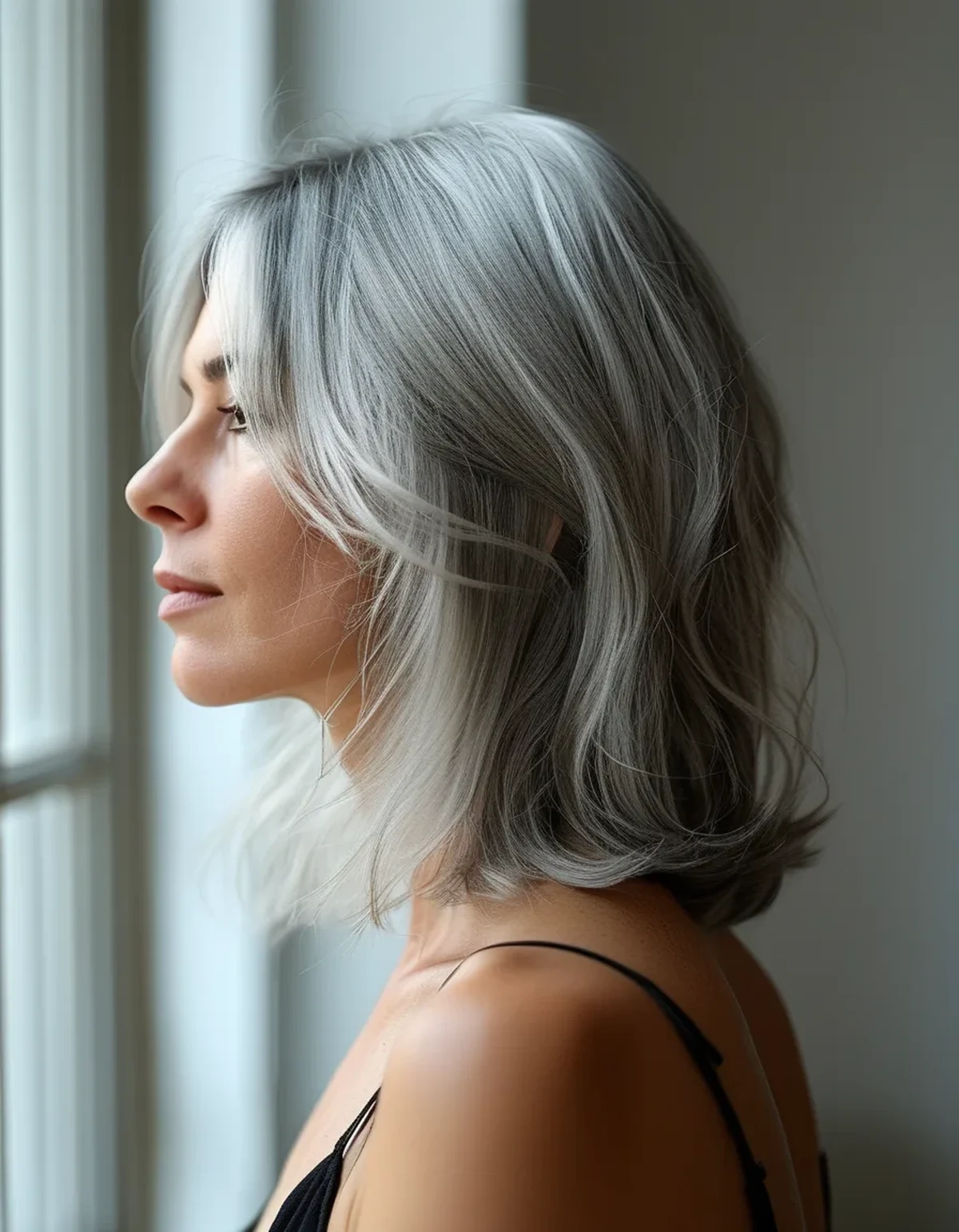
A collarbone or shoulder-length bob is the reliable workhorse. Long enough for the weight of the hair to help, short enough that thinning length at the ends is not the dominant impression.
Long layers, placed low. Layering is not the enemy; layering placed high at the crown is. Layers starting below the jaw remove bulk where the hair is heaviest without creating lift at the top, which is where grey hair already wants to expand.
A soft fringe if the hairline has thinned. A curtain or side-swept fringe covers a receding temple hairline far more elegantly than growing everything back, and it puts a soft edge against the face.
What to be cautious about: thinning shears. Coarse dry hair responds badly to internal thinning — you get short broken-off pieces that stand up through the length and increase the halo effect. A stylist who reaches for thinning shears on grey hair to “take the weight out” is usually about to make it worse. Ask for weight removed by cutting the perimeter or with careful slide-cutting instead.

What does the colour change mean for how the cut reads?
More than people expect, because silver is a low-contrast colour against most skin tones.
Dark hair creates a strong silhouette — the outline of the cut is the dominant visual. Silver and white hair have much less contrast against skin and background, so the outline matters less and the surface matters more. Shine, texture and how the light falls become the main visual, which is why a well-conditioned silver bob looks striking and a dry one looks flat regardless of the shape.
Practical consequences:
Shine is doing the work that colour used to. A gloss treatment, a good conditioning routine and a smooth finish matter more now than any styling shape does.
Yellowing shows immediately. Grey and white hair pick up yellow tones from minerals in water, from styling products, from UV and from smoke. A purple shampoo used sparingly — once a week or less, or you will go lilac — neutralises it. Over-use is a much more common problem than under-use.
Precision reads more clearly. Because the surface is what you see, a slightly grown-out shape shows sooner than it did on dark hair. Most people find they need a trim every eight to ten weeks rather than twelve.
And a defined shape flatters more than a soft one. Low-contrast hair with a soft undefined outline can read as vague; a clear line at the ends gives the whole thing intent.
What nobody tells you about growing it out
The awkward phase is a line problem, not a length problem. What is difficult is the horizontal demarcation between coloured ends and grey roots. Anything that breaks that line up — a soft balayage or a few highlights blended through the transition zone — makes the grow-out dramatically easier, and it is the single most useful thing a colourist can do for you during it.
Cutting shorter shortens the transition, arithmetically. Grey grows at roughly a centimetre a month. Going shorter removes coloured length, and there is no other way to shorten the process.
Your usual products will probably stop working. Volumising products are designed for hair that lies flat; grey hair often does not need volume, it needs weight and smoothing. A lot of people spend a year fighting their hair with the same mousse before switching to a cream or an oil and finding the problem solves itself.
Heat damage is more visible and more permanent. Without pigment there is nothing to disguise a damaged, porous end, and the roughened cuticle of grey hair is already more prone to it. Lower your straightener temperature by twenty or thirty degrees and use a heat protectant every time.
And it will change how colours near your face read. Colours that suited you against dark hair often look draining against silver — particularly muddy neutrals and warm beiges. Clear, saturated colours and true whites generally get better, not worse. That surprises people more than the hair itself does.
FAQ: Grey Hair Cut Questions, Answered
Should I go short when I go grey?
Not necessarily — that advice is a hangover from an era when it was mainly about shortening the grow-out. Long silver hair looks excellent when it is well conditioned and cut with a blunt perimeter. Go short if you want the transition over faster, not because of your age.
Why does my grey hair stick up at the crown?
Because grey strands are often more wiry and the crown is where new growth is most visible. Weight elsewhere helps, avoiding layers at the crown helps more, and a smoothing cream rather than a volumiser helps most.
How often should I use purple shampoo?
Less than most people do. Once a week is plenty for most, and every other week is enough if your water is soft. Over-use builds up and gives a dull lilac cast that looks worse than the yellow you were trying to fix.
Does grey hair really get coarser, or does it just feel that way?
It genuinely does in most people — the cuticle structure is rougher and sebum production is lower, both of which increase perceived coarseness. Individual strand diameter also often increases. It is a real physical change, not a perception one.
TL;DR:
- Grey hair is drier, often coarser and less uniform, so it separates and sits wider than pigmented hair did.
- Blunt perimeters and weight control it; high layering and thinning shears make it worse.
- With low colour contrast, shine and surface matter more than silhouette — condition and gloss do the work colour used to.
- Purple shampoo weekly at most, lower heat settings, and trims every eight to ten weeks.
The cut has not stopped suiting you. The hair changed underneath it, and the cut can change to match.
Keep Reading
This article is for general informational and styling purposes only. Fit, sizing, and product availability may vary.