How Often Should You Wash Gray Hair?
Quick Answer: Most people with gray hair do best washing every two to four days, which is less often than they washed before going gray. Gray hair is typically drier because sebum production declines with age and the cuticle is often more porous, so frequent washing strips it faster than it did. But scalp condition sets the floor - an oily or flaky scalp needs washing more often regardless of what the lengths want. Wash the scalp, condition the lengths, and use purple shampoo far less often than the bottle implies.
The honest answer is that there is no universal number, and the useful thing is knowing which signals to read.

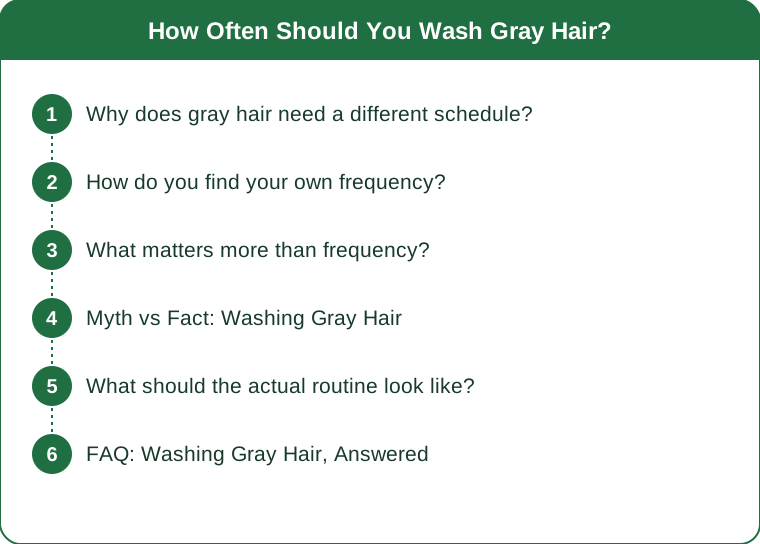
Why does gray hair need a different schedule?
Sebum production declines with age. The oil that travels down the hair shaft and keeps it flexible is produced in smaller quantities than it was in your thirties, so hair that used to look greasy on day two now looks fine on day three.
Gray hair is often more porous. The loss of melanin is accompanied by structural changes in many people, and a more porous cuticle both absorbs and loses moisture faster. That means it takes on water quickly in the shower and dries out quickly afterwards.
It is frequently coarser in diameter, which changes how it feels rather than how dirty it is. Coarse hair reads as dry and unmanageable long before it is actually dirty, which pushes people towards washing more rather than less.
It also picks up discolouration. Yellowing from minerals in hard water, styling products, sun exposure, and environmental pollution builds up on gray hair visibly in a way it does not on pigmented hair. Some washing is genuinely needed for this - it is the one argument in favour of more frequent washing.
And it responds to heat differently. Gray hair can be more sensitive to heat damage, so a schedule that involves blow-drying every wash is more damaging at this stage than the same schedule was twenty years ago.
The net effect for most people is a schedule stretched by one or two days, plus a change in what happens during each wash.
How do you find your own frequency?
Read the scalp, not the lengths. The lengths will almost always tolerate longer than the scalp will. If your scalp is itchy, flaky, or genuinely oily at the roots, you have hit the limit regardless of how the ends look.
Stretch it by one day at a time. Move from every day to every other day for two weeks before trying every third day. Gradual change lets sebum production settle rather than spiking.
Expect a couple of greasy weeks during any stretch. This is real, it settles, and it is the point most people abandon the attempt.
Use the roots as the signal. When the roots look flat and separated into strands by day three, that is your number. When the ends look dull and the roots are fine, the problem is conditioning, not washing.
Adjust seasonally. Most people need to wash slightly less in autumn and winter than in summer - less sweat, less sun, less swimming. But indoor heating starts drying the scalp from October onwards, and a schedule that works in September may need adjusting six weeks later when the heating comes on.
And adjust for activity honestly. If you train four times a week, sweat is going through your scalp whether or not you shampoo, and rinsing with water alone on non-wash days is a genuinely useful middle option.
What matters more than frequency?
Shampooing the scalp only, and conditioning the lengths only. This single change fixes more problems than any frequency adjustment. Shampoo is a cleanser for a scalp that produces oil; the ends do not produce oil and do not need cleansing.
Water temperature. Hot water strips more lipid and, on porous gray hair, roughens the cuticle. Warm to wash, cool to rinse.
A sulphate-free formula helps dry gray hair specifically. Sulphates clean effectively and strip more than gray hair can spare in most cases.
Hard water is a large hidden factor. Mineral deposits are what turn silver hair dull and yellow, and in a hard water area a chelating or clarifying shampoo once or twice a month does more for the colour than any purple product.
Purple shampoo is a toner, not a cleanser, and this is the most common gray hair mistake. Used every wash it deposits too much pigment and leaves a lilac or grey-violet cast. Once a week to once a fortnight is enough for most people, and it should be rinsed after two to three minutes rather than left on.
And a leave-in or light oil on the mid-lengths and ends does more for how the hair looks between washes than adding a wash would.

Myth vs Fact: Washing Gray Hair
Myth: gray hair is dry, so you should never wash it. Fact: the scalp still needs cleansing, and an unwashed scalp gets flaky and itchy. The dryness is a lengths problem, solved by conditioning, not by skipping washes.
Myth: washing less trains your scalp to produce less oil. Fact: sebum production is driven by hormones and genetics, not by training. What actually happens when you stretch washes is that you get used to how the hair looks on day three, and the distribution of oil down the shaft improves. That is a real benefit, but it is not retraining a gland.
Myth: dry shampoo is a substitute for washing. Fact: it absorbs oil at the roots and adds product to the scalp. Used repeatedly without washing, it contributes to build-up and irritation. It is a one-day bridge, not a replacement.
Myth: purple shampoo should be used every wash to keep silver bright. Fact: over-toning is one of the most common gray hair complaints, and the cure is using it far less often. Yellowing from hard water is better addressed by a clarifying wash than by more purple.
Myth: cold water rinses seal the cuticle shut. Fact: cooler water does help the cuticle lie flatter and improves shine, though the effect is modest. It is worth doing and it is not transformative.
Myth: you need a special gray hair shampoo. Fact: you need a gentle shampoo, good conditioning, and occasional clarifying. Whether the bottle says gray on it is marketing.
What should the actual routine look like?
Wash day: warm water, shampoo the scalp only, massage for 30 to 60 seconds, rinse thoroughly. Most people rinse for half as long as they should, and residue is a major cause of dullness.
Condition from the ears down, leave for two to three minutes, rinse cool. Conditioner on the scalp weighs down the roots and shortens the time until the next wash.
Once a week or fortnight, swap the shampoo for purple and rinse it out after two to three minutes. Watch for any violet cast and reduce the frequency if you see one.
Once or twice a month in a hard water area, use a clarifying or chelating shampoo to remove mineral build-up, and follow it with a deep conditioner because it will be drying.
Between washes: rinse with water after workouts, use a small amount of dry shampoo at the roots if needed, and a light leave-in on the ends.
Once a week, a deeper conditioning treatment on the lengths. Gray hair benefits from this more than pigmented hair does, and it is the step that makes a three-day gap look intentional rather than neglected.
And revisit the whole schedule when the heating comes on. The transition into a heated indoor environment in October is the single largest change your scalp and hair will experience all year, and it usually calls for more conditioning rather than more washing.
FAQ: Washing Gray Hair, Answered
Is every day too often for gray hair?
For most people, yes - it tends to leave the lengths dry without any benefit to the scalp. If your scalp is genuinely oily or you train daily, daily washing is fine, but use a gentle shampoo and condition properly.
Why does my gray hair look yellow after washing?
Usually mineral deposits from hard water, sometimes product build-up. A clarifying or chelating shampoo addresses it directly. Purple shampoo masks it and does not remove the cause.
How often should I use purple shampoo?
Once a week to once a fortnight for most people, rinsed after two to three minutes. If your hair looks lilac or dull violet, you are using it too often.
Does washing less make gray hair healthier?
It reduces mechanical and chemical stress on the lengths, which helps. It does nothing for the scalp, and an under-washed scalp becomes itchy and flaky, so there is a floor.
Should I change anything for winter?
Usually more conditioning rather than a change in wash frequency. Indoor heating dries both scalp and hair, and a weekly treatment plus a leave-in handles it better than washing more or less often.
TL;DR:
- Most people with gray hair do best on a two to four day cycle - longer than they washed before, because sebum production declines with age.
- Let the scalp set the floor: itchy, flaky, or oily roots mean wash, regardless of how the ends look.
- Shampoo the scalp only, condition the lengths only, and rinse for longer than feels necessary.
- Purple shampoo is a toner, not a cleanser - once a week to once a fortnight, rinsed after two to three minutes.
- Yellowing is usually hard water; a clarifying or chelating shampoo once or twice a month fixes what purple only masks.
Revisit the routine when the heating comes on in October. That transition dries hair more than any change in wash frequency will.
Keep Reading
This article is for general informational and styling purposes only. Fit, sizing, and product availability may vary.