Why Silver Hair Turns Yellow in Autumn and What Actually Fixes It
Quick Answer: Grey and white hair yellows because it has no melanin to mask discolouration, so anything that deposits on it shows immediately — hard-water minerals, product build-up, environmental pollutants, and oxidation from heat and UV. Autumn makes it visible because indoor lighting is warmer and daylight hours are shorter. The fix is usually clarifying and a chelating treatment, not more purple shampoo, which past a point deposits its own dullness.
It happened over about three weeks. Nothing changed in your routine, and the silver that looked crisp in August now looks slightly dirty — most obviously at the front and around the temples.
There are two separate things going on: your hair genuinely did discolour, and the light you are looking at it in changed. Both need addressing.

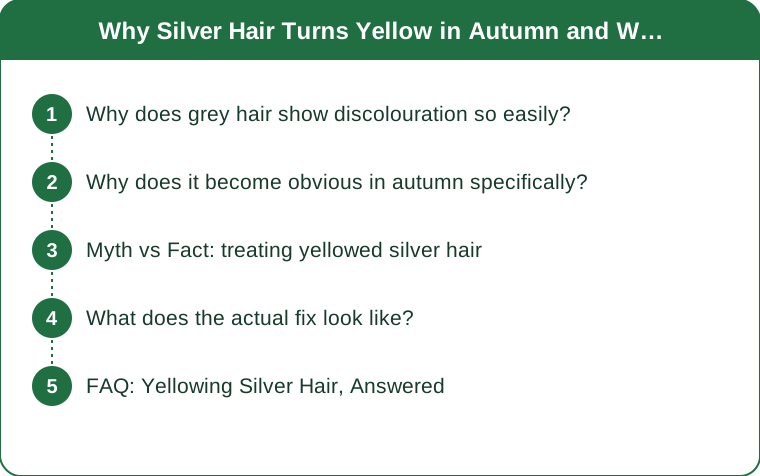
Why does grey hair show discolouration so easily?
Because there is nothing there to hide it.
Pigmented hair contains melanin, which absorbs light across a broad range and masks small colour shifts entirely. A little mineral deposit or oxidation on brown hair is invisible; the melanin swamps it.
Grey and white hair has little or no melanin. The hair shaft is essentially translucent, so anything deposited on or in it shows directly — and most of the things that deposit are yellow or brown.
Grey hair also tends to be structurally more porous. Reduced sebum production and cuticle changes with age mean the cuticle lies less flat, which lets more of the external world in and keeps it there.
The main culprits are consistent:
Hard water minerals, particularly iron and copper, which oxidise and leave a yellow-orange cast. This is the biggest single cause in most hard-water areas.
Product build-up from silicones, oils and styling products, which yellows as it oxidises.
Environmental pollutants and smoke, which grey hair picks up readily.
Oxidation from heat styling and UV, which affects the keratin itself.
Some medications and even chlorine add to it.
Why does it become obvious in autumn specifically?
Because you have changed what you are looking at it under.
Indoor lighting is warm. Most domestic bulbs sit around 2,700 to 3,000 Kelvin, heavily weighted toward the yellow-orange end. Daylight is around 5,500 to 6,500K. As the hours you spend under artificial light increase, you are viewing your hair under lighting that actively emphasises yellow tones.
Grey hair is uniquely affected by this because, being translucent and unpigmented, it reflects the colour of the light hitting it far more than pigmented hair does. Warm light literally makes it look warmer.
Daylight itself changes too. Autumn sun sits lower and its light is warmer in tone than the high summer sun you were seeing your hair in for months.
So part of what you are noticing is real discolouration accumulated over months, and part of it is a lighting change revealing what was already there.
The practical test: look at your hair in daylight, near a window, at midday. If it looks fine there and yellow in your bathroom, the problem is at least partly the bulb — and a higher-Kelvin bathroom bulb is a cheap and surprisingly effective intervention.

Myth vs Fact: treating yellowed silver hair
Myth: more purple shampoo will fix it. Fact: purple shampoo neutralises yellow tones by depositing violet pigment. It does nothing to remove mineral deposits or build-up, which is what most autumn yellowing actually is. Worse, over-use deposits enough violet to leave hair looking dull, grey-lilac or muddy, and on porous grey hair it can stain unevenly. Once or twice a week is plenty for most people.
Myth: yellowing means your hair is damaged. Fact: usually it means something is sitting on it. Mineral build-up and product residue are removable and are not damage.
Myth: clarifying shampoo removes mineral build-up. Fact: clarifying shampoo removes product build-up. Removing metals requires a chelating treatment, which contains agents such as EDTA or phytic acid that bind minerals. These are different products and the distinction is the single most useful thing to know here.
Myth: a shower filter is a gimmick. Fact: in a genuinely hard-water area, a filter that reduces metal content is one of the more effective preventative measures available for grey hair specifically.
Myth: you should wash grey hair less to avoid stripping it. Fact: build-up is the main enemy, so under-washing tends to make yellowing worse. Grey hair generally does better with regular gentle washing than with long gaps.
What does the actual fix look like?
A sequence, done once, then maintained.
Step 1: chelating treatment. Use a chelating or demineralising shampoo to strip accumulated metals. Once, then no more than monthly — these are strong products. This is the step that resolves genuine mineral yellowing and the one most people have never tried.
Step 2: deep condition immediately after. Chelating leaves hair feeling rough because it has removed everything, minerals included. A good conditioning mask straight afterwards restores the feel.
Step 3: reassess before using purple. After chelating, a fair proportion of the yellow is simply gone. Judge what is left in daylight before reaching for toning products — you may need much less than you thought.
Step 4: purple, sparingly. Once or twice a week maximum, left on for the stated time and no longer. If your hair has gone dull or lilac from over-use, stop entirely for two to three weeks and it will clear.
Maintenance: a clarifying wash every two to three weeks for product build-up, a chelating wash monthly in a hard-water area, heat protection when styling, and UV protection in summer. A shower filter if your water is hard is the single best preventative purchase.
FAQ: Yellowing Silver Hair, Answered
How do I know if it is minerals or product build-up?
Minerals typically produce a yellow-orange cast that is worse at the ends and on the sections most exposed to water. Product build-up tends to look dull and slightly grey-yellow overall and often comes with hair that feels coated. If a clarifying wash makes little difference, suspect minerals and try chelating.
Can I use purple conditioner instead of shampoo?
Yes, and for many people it is gentler and easier to control — the pigment is deposited alongside conditioning agents and tends to be more even on porous hair. It still needs the same restraint on frequency.
Will yellowing come back?
If the cause is your water, yes, gradually — which is why monthly chelating or a filter is the maintenance answer rather than a one-off fix. Build-up from products returns on its own schedule depending on what you use.
TL;DR:
- Grey hair has no melanin to mask deposits, so minerals, product and oxidation show immediately.
- Autumn makes it obvious because warm indoor light emphasises yellow — check in daylight first.
- Chelating removes minerals; clarifying removes product. They are different treatments.
- Purple shampoo tones but does not remove — and over-use causes dullness of its own.
- A shower filter in a hard-water area is the best preventative.
Try one chelating wash and a deep conditioner before you buy anything else. Most autumn yellowing is sitting on the hair rather than in it.
Keep Reading
This article is for general informational and styling purposes only. Fit, sizing, and product availability may vary.