Why Your Gray Hair Holds a Style Worse Once the Heating Comes On
Quick Answer: Gray hair has a coarser cuticle, less sebum reaching the shaft, and often a more porous structure than pigmented hair - which means it both absorbs and loses moisture faster. When indoor humidity falls below about 40 percent as heating starts, gray hair dries out and loses the flexibility a style depends on. The fix is a humectant plus a sealing layer, not more product.
It is a specific, seasonal frustration. The style that held all summer collapses by mid-morning, and the hair feels different under your hands - drier, wirier, less willing.
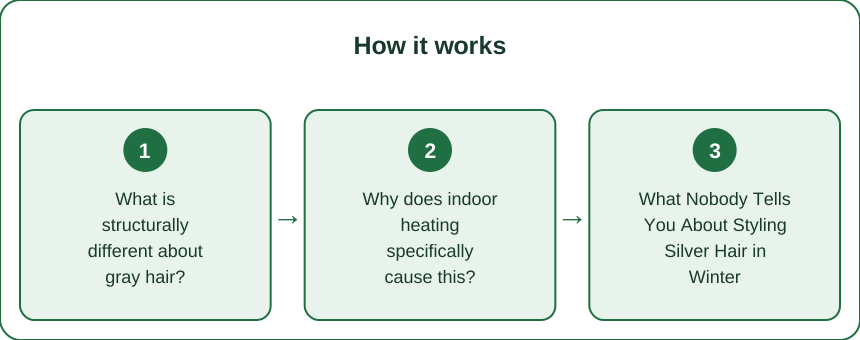
What is structurally different about gray hair?
Melanocytes stop producing pigment, but that is not the only change. Alongside pigment loss, the shaft typically becomes coarser in diameter, the cuticle scales sit differently, and the hair often develops a more irregular cross-section - which is why gray hair frequently grows in with a different texture and even a different curl pattern than the hair it replaced.
Sebum distribution changes. Sebum travels down the shaft from the scalp, and a coarser, more irregular surface transports it less efficiently. Combined with the general reduction in sebum production that comes with age, the mid-lengths and ends of gray hair receive noticeably less natural conditioning.
Porosity is usually higher. A cuticle that does not lie completely flat allows water in quickly and out just as quickly. That is why gray hair can feel simultaneously dry and prone to frizz - both are symptoms of the same porosity issue rather than opposite problems.
And it is more vulnerable to UV and environmental damage without melanin providing some protection. A summer of sun exposure leaves gray hair in worse condition entering autumn than pigmented hair in the same conditions, which is part of why the heating-season decline feels so abrupt.
Why does indoor heating specifically cause this?
Heated indoor air can drop to 30 percent relative humidity or lower. For reference, comfortable is 40 to 50 percent. Hair is hygroscopic - it exchanges moisture with the surrounding air continuously - and porous gray hair reaches equilibrium with dry air faster than sealed, healthy pigmented hair does.
Dry hair loses elasticity, and elasticity is what holds a style. A style is essentially hydrogen bonds reformed into a new shape. Hair with adequate moisture content is flexible enough to hold that shape; hair below roughly 10 percent moisture content becomes brittle and springs back toward its natural pattern.
Static compounds the problem visibly. Dry air plus dry hair produces static charge, which makes individual strands repel each other. That is the halo effect that appears within days of heating starting, and no amount of smoothing product fixes it if the underlying moisture content is wrong.
The temperature swing matters too. Moving between a 68F heated interior and a 45F exterior several times a day means repeated expansion and contraction of the cuticle, which increases cuticle lifting over a season.
And most people respond by adding more styling product, which usually contains drying alcohols and makes the fundamental problem worse while temporarily hiding the symptom.
What Nobody Tells You About Styling Silver Hair in Winter
Humectants alone can backfire in dry air. Glycerin-heavy products pull moisture from the air in humid conditions and from your hair in dry conditions. In a heated house in January, a glycerin leave-in without an occlusive layer over it can leave hair drier than using nothing. Always seal it - an oil, a silicone, or a cream on top.
Room humidity is a hair product. A bedroom humidifier held at 45 percent does more for gray hair through winter than any single product change. It is the least glamorous advice in hair care and the most consistently effective.
Heat styling requires lower temperatures on gray hair, not the same. Coarser texture tempts people to increase heat, but gray hair without melanin shows heat damage faster and yellows with repeated high heat. Stay below about 350F and use a heat protectant every time.
Yellowing is often product buildup, not damage. Silver hair picks up residue from styling products, hard water minerals, and even smoke, and it shows every bit of it. A clarifying wash every few weeks does more for brightness than purple shampoo used constantly - and overusing purple shampoo produces its own dull, slightly lilac cast.
And the cut is doing more work than you think. As texture coarsens, the weight distribution that worked at 40 stops working. Gray hair generally holds shape better with slightly more internal layering and slightly less length than the same head of hair needed a decade earlier. If nothing you do is working, the answer may be the shape rather than the products.
FAQ: Gray Hair Questions, Answered
Should I switch to a different shampoo for winter?
Usually yes, in one specific direction - toward lower cleansing strength. If you use a clarifying or volumizing shampoo year-round, moving to a cream or moisturizing formula for the heating months addresses the actual problem. Keep a clarifying one for every third or fourth wash to handle buildup.
Why does my gray hair feel wiry only at the front?
The hairline typically grays first and has been gray longest, so it has had the most cumulative exposure and the most time to become porous. It is also the section most exposed to sun, wind, and heat styling. Treating the front section with a heavier leave-in than the rest is a reasonable and common approach.
Does gray hair actually grow faster or slower?
Neither meaningfully - growth rate is largely unchanged. What changes is retention: more fragile, drier hair breaks more, so it appears to stop growing at a certain length. Improving moisture and reducing mechanical stress usually reveals that the growth was there all along.
TL;DR:
- Gray hair is coarser, more porous, and receives less sebum, so it exchanges moisture with the air faster.
- Indoor heating drops humidity below 40 percent, which strips the elasticity a style depends on.
- Humectants need an occlusive layer over them or they can pull moisture out of the hair in dry air.
- A bedroom humidifier at 45 percent outperforms any single product change.
- Lower heat styling temperatures, clarify for buildup, and reconsider the cut if nothing else works.
Keep Reading
This article is for general informational and styling purposes only. Fit, sizing, and product availability may vary.