Managing the Gray Grow-Out Line Without Cutting It All Off
Quick Answer: Hair grows about half an inch a month, so the line between silver roots and dyed lengths moves slowly - and months four through eight are where most women quit. The realistic toolkit: salon blending (fine highlights and lowlights that scatter the line), a demi-permanent gloss to soften contrast, root powders as a bridge for events, and styling that breaks up the straight edge - texture, zigzag parts, strategic updos. The big chop is one valid option, not the price of admission.
Nobody warns you that going gray is mostly a waiting game with one hard level: the horizontal line that follows you around for a year. The women who make it through rarely have more willpower - they have better tactics for the middle months.

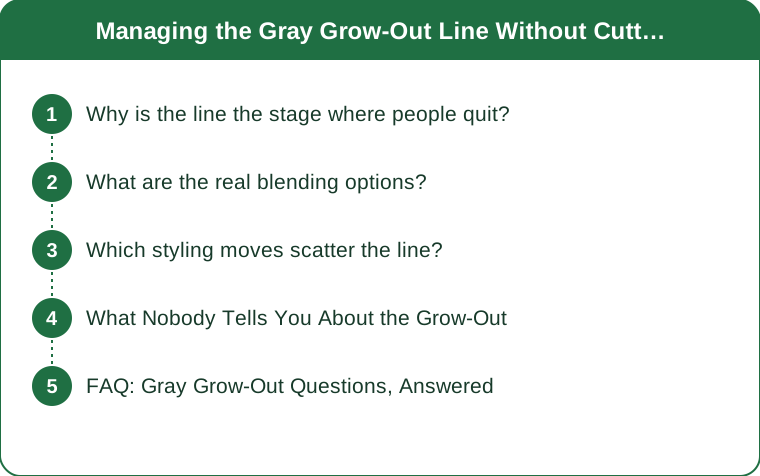
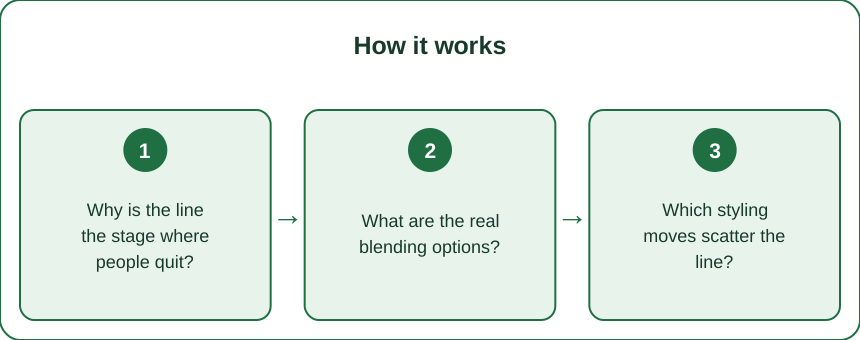
Why is the line the stage where people quit?
Because the math is slow and the mirror is loud.
The arithmetic is unforgiving. Hair grows roughly half an inch a month - six inches a year. Shoulder-length hair means a two-year transition if you grow it straight out; even a chin-length bob commits you to twelve-plus months of visible line. Knowing the number upfront matters, because vague expectations are what turn month five into a dye relapse.
Contrast is the real enemy, not silver. The line is most brutal where dyed hair is darkest - near-black dye against bright silver regrowth creates a hard horizontal stripe that reads from across a room. Women growing out from lighter dye shades often barely register a line at all. The tactics below are all, in one way or another, contrast-reduction.
Months four through eight are the wall. Too much regrowth to hide, too little to style as intentional. The novelty of the decision has worn off, the compliments have not started, and one boring Tuesday in front of a mirror undoes eight months of patience. Naming the wall in advance is half of surviving it.
The mirror exaggerates and photographs lie in both directions. Overhead bathroom lighting hits the part line - the maximum-contrast zone - while everyone else sees your hair at angles where the blend is kinder. Meanwhile silver reflects light differently than pigmented hair, reading brighter in flash photos.
And texture changes the difficulty rating. Waves and curls scatter the line by constantly rearranging where roots meet lengths; poker-straight hair displays it like a ruler. Straight-haired women are playing on hard mode and deserve the salon-assist options most.
What are the real blending options?
A spectrum from full salon strategy to drugstore bridge, all compatible with each other.
Salon blending is the gold standard for dark dye. A colorist weaves fine highlights through the dyed lengths and sometimes lowlights through the regrowth - scattering silver-adjacent tones downward and pigment upward until the line dissolves into a gradient. Two or three sessions spaced over the transition can shrink a two-year visual ordeal into a soft, deliberate-looking ombre. Ask for gray blending specifically; it has become a standard service.
A demi-permanent gloss is the low-commitment multiplier. Demi color deposits without lifting, softening the dyed portion toward a lighter, cooler shade that argues less with the silver - and it fades gradually rather than creating its own line. Glossing also fixes the brassiness of old dye as it oxidizes, which is half of what makes grow-outs look unkempt rather than intentional.
Root concealers are the event bridge, used strategically. Tinted powders and sprays cover the line for a wedding or an interview and wash out that night. The trap is daily use - concealing every day quietly turns the grow-out back into upkeep, which is the treadmill you were leaving. Save them for occasions and let ordinary days be transitional.
What to skip: stripping the dye in one sitting. Color remover and heavy bleach sessions promise a shortcut to all-over silver and frequently deliver damage plus a brassy mid-tone that needs its own correction. Slow blending beats fast wrecking - the hair on your head has to survive the impatience.
And decide with a photo, not a feeling. Take the same selfie in the same window light monthly. Progress that is invisible day-to-day is dramatic month-to-month, and the photo series is the antidote to the month-five wobble.

Which styling moves scatter the line?
Free, immediate, and collectively worth as much as the salon.
Texture is the number one tool. Waves - from a curling wand, overnight braids, or heatless rollers - constantly rearrange which strands sit where, breaking the straight horizontal into scattered glints. The difference between air-dried-straight and loosely waved is the difference between a stripe and a blend. Curly-haired women get this for free.
Move the part, then keep moving it. A zigzag part scatters the regrowth line at its most visible location; a deep side part stacks volume that shadows the roots. Rotating part placement also prevents the sun-fade stripe from settling in one spot through late summer.
Updos mix the timeline on purpose. A loose bun, a braided crown, or a claw-clip twist pulls silver roots and dyed lengths into the same visual plane - the mixing IS the styling. High-contrast grow-outs often look best on updo days, which is worth knowing before big-photo events.
Curtain bangs and face-framing layers do double duty. New growth around the face is where silver usually concentrates first, and layers that begin there convert the brightest regrowth into what reads as deliberate face-framing brightness. Ask for it exactly that way.
Shine sells the story. Silver reads by reflection - well-conditioned, glossed, light-catching hair in transition looks premeditated, while dry and diffuse reads as neglected. A weekly deep-conditioning mask and a shine serum are transition equipment, not vanity.
And accessories earn their moment. A wide headband or silk scarf placed at the demarcation zone is the only styling tool that covers the line completely while looking like a choice - the honest workhorse of months four through eight.
What Nobody Tells You About the Grow-Out
The silver has a different texture, and it needs different care. Gray strands are often coarser, drier, and more wiry than pigmented hair ever was - the follicle produces less oil as it produces less pigment. The conditioner budget shifts up a tier during transition, and a leave-in becomes standard equipment. Fighting the texture with heat every day undoes the shine that makes silver look silver.
Purple shampoo is a weekly tool, not a daily religion. Silver picks up yellow from minerals, product, and sun - a violet-toned wash once or twice weekly neutralizes it. Overuse deposits a lilac cast and flattens the brightness you waited a year for. If the water at your house runs hard, a clarifying wash occasionally matters as much as the purple.
The old dye keeps changing underneath you. Dyed lengths oxidize warmer - brassier - as months pass, which widens the visual gap against cool silver even while the line physically grows out. This is why a grow-out can look worse at month six than month three without anything going wrong. The fix is the gloss, not surrender.
People notice dramatically less than you think. The line that dominates your mirror time typically goes unmentioned for months - and the comments that do come skew positive, often envious. The audience for the demarcation line is almost entirely internal.
The final chop is a choice, not a defeat. Many women ride the blend to collarbone length and then cut to a silver bob, trading the last eight months of waiting for an afternoon. Others grow every inch. Both finish lines count - the goal was leaving the dye treadmill, and either route arrives.
And the roots you are studying are the preview. That inch of silver at the part is the only honest sample of what the finished color will be - brighter, cooler, and more dimensional than the mental image formed from fear. Most women report the real thing beat the dread.
FAQ: Gray Grow-Out Questions, Answered
How long does growing out gray hair take?
Hair grows about half an inch monthly, so full transition takes roughly as many years as your hair is long in feet - around two years for shoulder length, twelve-ish months for a bob. Salon blending does not speed the growth but collapses the awkward-looking portion from a year-plus down to a few months of soft gradient.
Do I have to cut my hair short to go gray?
No - the pixie is the fastest route, not the mandatory one. Blending highlights, glossing, and styling tactics let you keep length through the entire transition. Many women split the difference: grow with blending to collarbone, then trim to a bob for the final stretch.
What is a gray blending service exactly?
A colorist weaves fine highlights through your dyed lengths - and often lowlights through the silver regrowth - so the hard line becomes a scattered gradient. It typically uses foils plus a toner or gloss, costs what a highlight appointment costs, and needs refreshing two or three times across a transition rather than every four weeks like root dye.
Does purple shampoo help during the grow-out?
Yes, for keeping the incoming silver bright - it neutralizes the yellow cast from minerals, sun, and product buildup. Use it once or twice a week, not daily, or the violet deposits and dulls the shine. It does nothing for the demarcation line itself; that is the gloss-and-blending department.
TL;DR:
- The line moves half an inch a month; months four through eight are the wall - plan for it by name.
- Contrast is the enemy: blending highlights, lowlights, and a demi gloss dissolve the stripe.
- Free tactics daily: waves, zigzag parts, updos, face-framing layers, and a headband at the line.
- Silver is drier - upgrade conditioning, gloss for shine, purple shampoo weekly not daily.
- Root concealers are for events, not every day - and the big chop is one option, never the toll.
The grow-out was never really about patience. It is a contrast-management project with a two-year clock - and every tactic above shortens the part that hurts.
Keep Reading
This article is for general informational and styling purposes only. Fit, sizing, and product availability may vary.