Does Water Temperature Actually Matter for Gray Hair?
Quick Answer: Water temperature matters more for gray hair than for pigmented hair, but not for the reason usually given. Hot water does not open and close the cuticle like a door — that idea is overstated. What hot water genuinely does is strip sebum faster, and gray hair is already drier and coarser because the follicle produces less oil as it loses pigment. Lukewarm washing with a cool final rinse is the practical answer, and the cool rinse helps shine more than it helps anything else.
There is a lot of confident advice about water temperature and almost none of it distinguishes between what is proven and what is repeated.
Here is the honest version, and what actually changes when you adjust it.

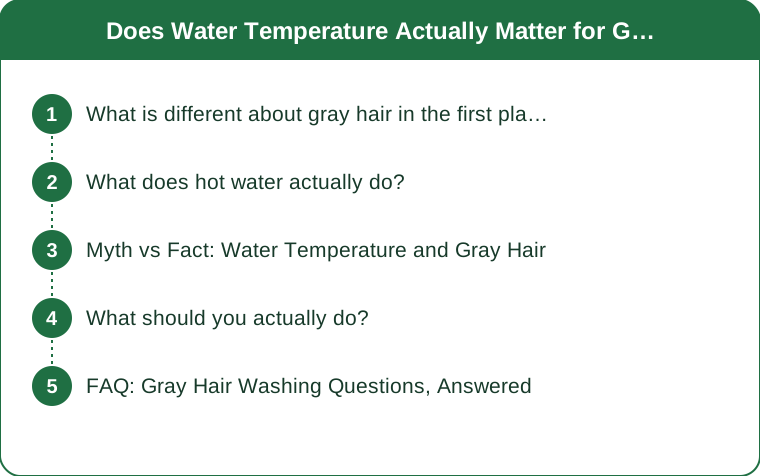
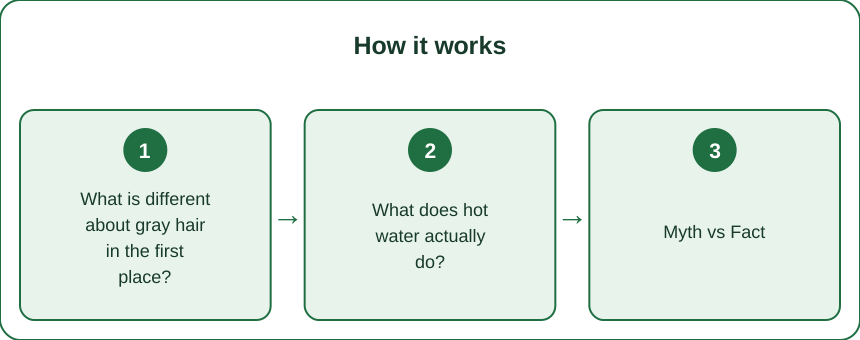
What is different about gray hair in the first place?
Several things change at once when a hair loses pigment, and only one of them is colour.
Melanocyte activity declines, and so does sebum production. The same follicles that stop producing pigment tend to produce less oil, which is why gray hair is characteristically drier and why it feels different between the fingers.
The texture often changes. Gray hairs are frequently coarser, more wiry and have a different diameter than the pigmented hairs on the same head, and many people find they take on a slight curl or kink that was not there before. This is a structural change, not a styling problem.
The cuticle is often rougher. A rougher cuticle scatters light rather than reflecting it evenly, which is why gray hair can look dull even when it is healthy, and why smoothing treatments make a bigger visible difference than they do on pigmented hair.
Melanin was doing UV protection work. Pigment absorbs some ultraviolet radiation, so gray hair has less built-in protection and is more susceptible to sun-driven damage and yellowing.
And gray hair shows everything. Product buildup, hard water minerals, chlorine, smoke, and pollution all deposit visibly on a pale fibre where they would be invisible on dark hair. This is why gray hair care is disproportionately about what you remove rather than what you add — and it is directly relevant to the temperature question, because temperature changes how well things rinse away.
What does hot water actually do?
Three real effects, and one commonly cited effect that is oversold.
It removes sebum efficiently. This is the main, genuine mechanism. Warm water and surfactants together lift oil far more effectively than cool water does. On oily hair that is desirable. On gray hair that is already under-oiled, it means stripping a protective layer the scalp is slow to replace.
It dries the scalp. Prolonged hot water on skin disrupts the lipid barrier, and the scalp is skin. Hot showers are a well-recognised contributor to dry, itchy, flaking scalps — which people then treat with more frequent washing, compounding it.
It increases dye and toner fade. If you use a purple or blue toning shampoo, a gloss, or any deposited colour, hot water accelerates its release. Anyone toning brassiness will notice the effect within a couple of washes of changing temperature.
The cuticle claim is oversold. The popular version — hot water opens the cuticle and cold water seals it shut — treats the cuticle like a hinged lid. In reality the cuticle scales do lift somewhat when hair is wet and swollen, and they lie flatter as hair dries and contracts, but temperature is a modest contributor compared with wetness itself, pH and mechanical handling. A cold rinse does produce a smoother, shinier result for many people — the effect is real, the mechanism is just less dramatic than the story suggests.
pH does more than temperature. An acidic rinse or a conditioner formulated at a low pH flattens the cuticle far more reliably than cold water does. If shine is the goal, the conditioner matters more than the tap.

Myth vs Fact: Water Temperature and Gray Hair
Myth: Cold water seals the cuticle shut. Fact: The cuticle is not a valve. Cool water contributes to a smoother surface, but hair drying and contracting does most of that work, and conditioner pH does more than either. A cool rinse is still worth doing — just for shine, not for a seal.
Myth: Hot water turns hair yellow. Fact: Heat does not create yellowing directly. What hot water does is strip toner faster and remove oils, both of which let underlying yellow tones and mineral deposits show. The yellow was already there or is arriving from elsewhere — hard water, sun, product, smoke.
Myth: You should wash gray hair in cold water. Fact: Genuinely cold water cleans poorly, because surfactants work less effectively and residue is more likely to remain. Residue on gray hair is highly visible. Lukewarm washing with a cool rinse is the useful compromise.
Myth: Gray hair needs washing less often because it is drier. Fact: Wash frequency should follow your scalp, not your hair colour. An oily scalp with gray hair still needs regular washing, and stretching washes on gray hair often just means visible buildup on a pale fibre.
Myth: A cold rinse makes hair grow faster by stimulating the scalp. Fact: No. Temperature-driven changes in scalp blood flow are transient and there is no evidence they affect growth rate.
Myth: Hard water is only a problem if you can see limescale. Fact: Mineral deposition on hair is invisible until it accumulates, and it is a major driver of dullness and yellowing in gray hair specifically. If your kettle furs up, your hair is collecting the same minerals, and hotter water deposits them slightly more readily.
What should you actually do?
A short routine, in the order it happens in the shower.
Wash at lukewarm. Comfortable, not steaming — the temperature at which you would happily wash your hands. This cleans effectively without aggressive stripping.
Keep the hot water off your scalp specifically. If you like hot showers, that is fine for your back; it is the scalp and the length that pay for it. Washing your hair at the start of the shower before the temperature climbs is an easy way to manage this.
Rinse the conditioner out with cool water. Not ice cold — just noticeably cooler. Thirty seconds is enough. The improvement in shine is real and it costs nothing, and it also ensures the conditioner is fully rinsed, which matters because residue shows on gray hair.
Use an acidic or pH-balanced conditioner and give it a minute rather than rinsing immediately. This does more for cuticle smoothness than any temperature change.
Add a chelating or clarifying wash if you have hard water, roughly every two to four weeks. This addresses the mineral buildup that temperature adjustments cannot touch, and for many people it is the single biggest visible improvement available to gray hair.
Do not over-use purple shampoo. It is a toner, not a cleanser, and used every wash it deposits enough to leave a dull violet cast. Once a week or once a fortnight is plenty for most people, and adjusting water temperature to preserve the tone means you need it less often.
Protect from heat styling more than from water. A hairdryer or straightener applies far more thermal energy to hair than any shower can, and gray hair is more vulnerable to it. If you are auditing heat exposure, start there.
Seasonally, this is the moment it changes. Two things arrive together in autumn: hotter showers, because you are cold, and indoor heating, which drops indoor humidity substantially. Gray hair is already dry and both of these push it further. If your hair felt fine all summer and is suddenly straw-like in October, the cause is usually the shower and the radiator, not a product that stopped working.
This is general information, not medical advice — persistent scalp itching, flaking or hair loss is worth a proper look from a dermatologist.
FAQ: Gray Hair Washing Questions, Answered
What temperature exactly?
There is no magic number. Comfortable-warm for washing, noticeably cooler for the final rinse. If it steams the mirror, it is hotter than gray hair wants.
Will a cold rinse really make my hair shinier?
Many people see a genuine difference, and it costs thirty seconds. Just do not expect it to outperform a good conditioner or a chelating treatment for hard water.
Does temperature affect brassiness?
Indirectly. Hotter water fades toner faster and strips oil, which lets underlying yellow show. The yellow itself usually comes from minerals, sun or product, not from the water’s heat.
Should I use a shower filter?
If you have hard water and gray hair, it is one of the more worthwhile purchases. It will not perform miracles, but reducing ongoing mineral deposition is easier than repeatedly removing it.
How often should I wash gray hair?
Follow your scalp. Two to three times a week suits many people with drier gray hair, but an oily scalp needs more, and buildup shows badly on pale hair. Colour is not the deciding factor.
Does any of this help with texture change?
Not directly — the wiriness comes from the follicle and cannot be washed away. What good moisture and a smooth cuticle do is make the existing texture behave better and reflect more light, which is most of what people actually want.
TL;DR:
- Gray hair is drier because the same follicles that lose pigment also produce less sebum — hot water strips what little there is.
- The open-and-close cuticle story is overstated. A cool rinse helps shine; conditioner pH helps more.
- Hot water fades toner faster, which is why brassiness seems to return sooner after hot showers.
- Lukewarm wash, cool rinse, acidic conditioner, and a chelating wash every few weeks for hard water.
- Heat styling does far more thermal damage than any shower. Audit that first.
If your hair changed character this month, look at the shower temperature and the radiators before you blame a product.
Keep Reading
This article is for general informational and styling purposes only. Fit, sizing, and product availability may vary.