Why Gray Hair Looks Different in Photos Than in the Mirror (It's Not Just Lighting)
Quick Answer: Gray hair has no pigment asserting its own color, so it reflects whatever color is in the room — and cameras handle that far worse than your eyes do. Your brain color-corrects in real time; a camera’s white balance guesses, and it guesses badly on low-color subjects like gray. Add a different cuticle texture that scatters light differently, and you get yellow-looking photos of hair that’s genuinely bright in person. Shoot in neutral daylight, set white balance manually, and stay away from strongly colored walls.
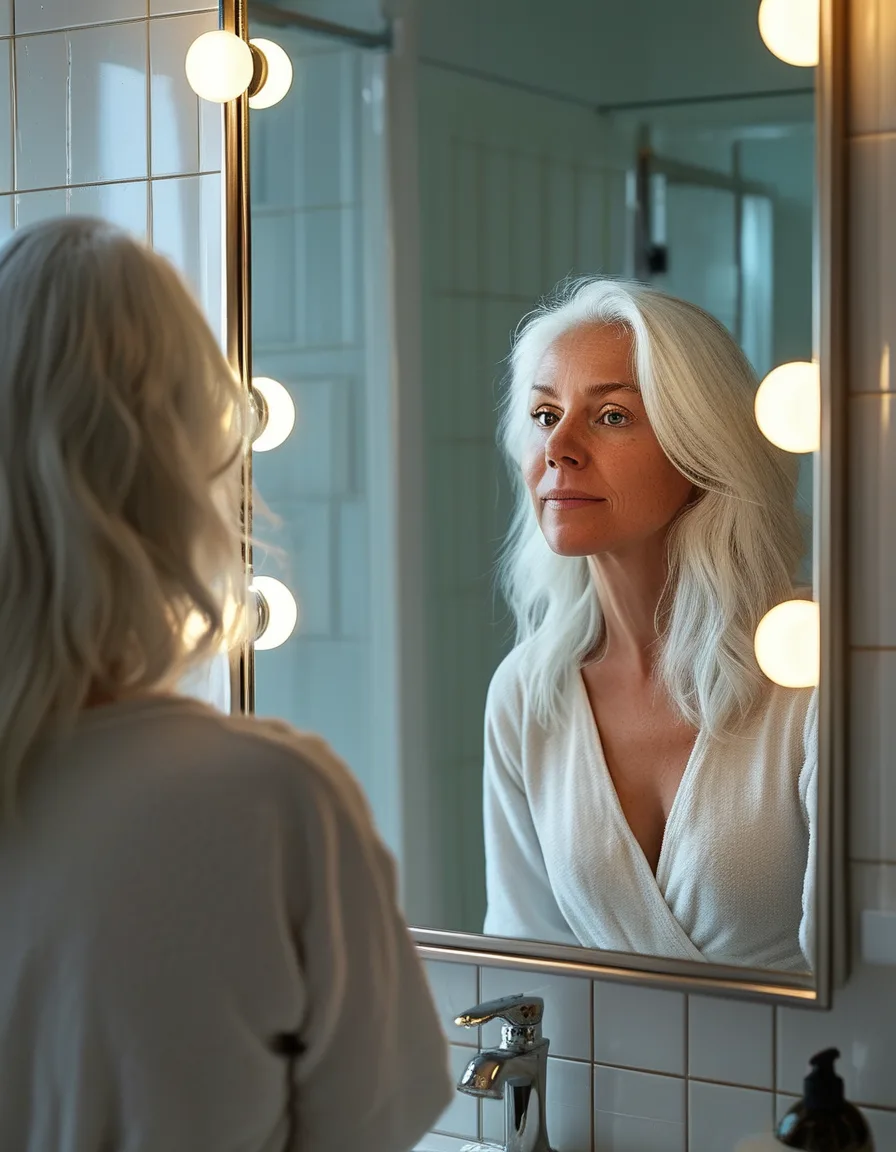
The mirror says bright, cool, silver.
The photo says slightly damp straw.
Same hair, same five seconds apart. Only one of them is lying, and it’s not the mirror.
Why Does Gray Hair Photograph So Differently?
Three things stacking, and only one of them is lighting.
Gray strands have a different surface texture. The cuticle on gray hair often differs from pigmented hair — it’s frequently coarser and more textured. That changes how light scatters off the strand. A camera sensor and a human eye interpret that scatter pattern differently, which is why the same head of hair can look glossy in person and flat in an image.
No pigment means no color of its own to assert. This is the big one. Pigmented hair has melanin insisting on brown or red regardless of the room. Gray hair doesn’t. With nothing of its own to contribute, it reflects whatever color is in the ambient light — warm bulbs, a beige wall, a yellow lampshade. It becomes a mirror for the room’s color cast in a way brown hair simply doesn’t.
Your brain corrects in real time; a camera has to guess. Human vision performs continuous automatic white balance — you know the white shirt is white under warm light, so you see it as white. A camera’s white balance algorithm has to infer the same thing from the scene, and it’s much less adaptive. It leans hardest on the colors present in the frame to make that judgment — which means a subject with almost no inherent color of its own gives it the least to work with. Gray hair is exactly that subject.
So it’s not bad lighting alone, and it isn’t your hair. It’s a subject that happens to be maximally difficult for a camera to render.
Why Does This Matter More With Gray?
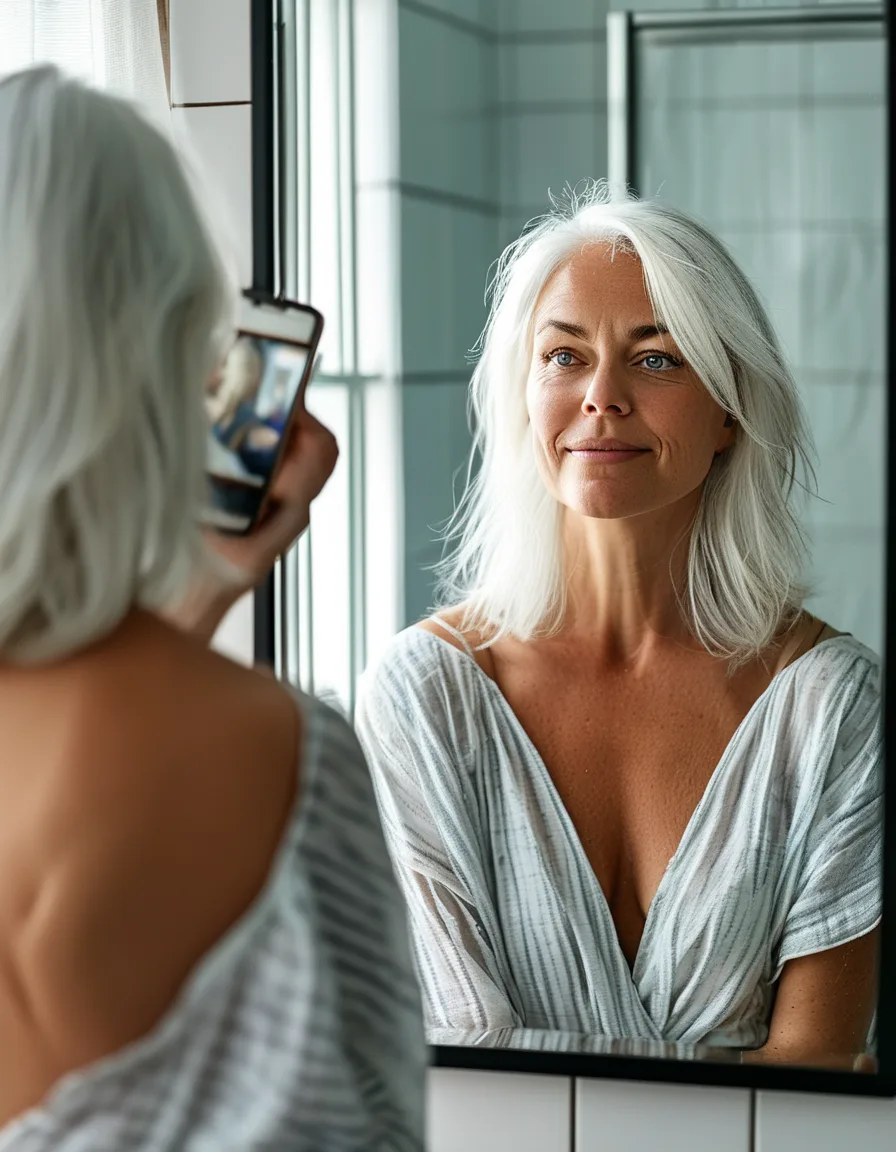
Because a lot of people are photographing gray specifically to track it. A grow-out or transition gets documented on purpose — monthly photos, progress comparisons, sharing with a stylist or an online community. When the entire point of the photo is the color, inaccurate color rendering doesn’t just look odd. It defeats the purpose.
And it produces real, unnecessary doubt. Someone whose hair looks genuinely bright and cool in the mirror sees a yellow-tinted photo and concludes the color is a problem — starts buying purple shampoo they don’t need, or second-guesses a transition that was going fine. The photo was wrong, and it changed a decision. That’s worth understanding rather than shrugging off.
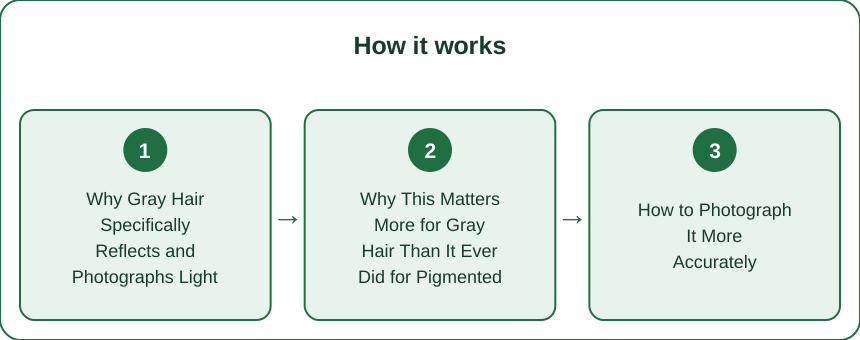
What Nobody Tells You About Photographing Gray Hair
Neutral daylight beats every indoor setup. Near a window on an overcast day, or outside in open shade, is close to ideal — even, neutral, no strong cast. Direct midday sun blows out the highlights; warm indoor bulbs push everything yellow; mixed lighting (a window plus a lamp) is the worst of all because the camera has two conflicting references and will split the difference badly.
Set white balance manually, or correct it afterward. On a phone, tap-and-hold to lock exposure and white balance before shooting, or use a pro/manual mode if you have one. Even easier: hold a plain white sheet of paper in the frame for one reference shot, then use it to correct the rest. The camera’s automatic guess is precisely the thing failing here, so overriding it fixes the root cause.
Watch what’s around you, not just above you. A beige wall, a wooden fence, a yellow towel, a red jacket — any of these will throw color onto gray hair and the camera will faithfully record it. Pigmented hair mostly ignores this. Gray hair doesn’t. Shoot against a neutral background, wear something neutral, and check what’s within a few feet of you.
Shoot the same way every time for comparisons. If you’re documenting a transition, fix the location, time of day, and orientation. Two photos taken under different light aren’t comparable regardless of how careful you were with each individually.
Mini FAQ
Does this mean my hair isn’t actually yellow?
Often, yes — check in neutral daylight, not in the photo and not under bathroom bulbs. Gray hair genuinely can yellow from product buildup, minerals in water, heat, and sun, so it’s worth confirming. But confirm it in real light before you treat it.
Why do salon photos look better?
Salons typically use neutral, even, high-quality lighting and photograph against a plain backdrop. They’ve removed all three problems at once. It’s not a filter — it’s just controlled conditions.
Should I use portrait mode or filters?
Portrait mode is fine for depth of field but often applies skin-tone processing that shifts hair color too. For accurate color, plain photo mode with corrected white balance beats any filter.
TL;DR:
- Gray hair has no pigment to assert, so it reflects whatever color the room contributes.
- Different cuticle texture scatters light in a way cameras and eyes read differently.
- Your brain white-balances automatically; a camera guesses, and guesses worst on low-color subjects.
- Shoot in neutral daylight or open shade — avoid warm bulbs and mixed lighting.
- Set white balance manually, keep colored surfaces out of the scene, and standardize conditions for progress shots.
Keep Reading
This article is for general informational and styling purposes only. Fit, sizing, and product availability may vary.