Your Haircut Needs to Change as You Go Gray — Here Is What Actually Changes
Quick Answer: Gray hair is often coarser, drier and more wiry than the pigmented hair it replaced, and it reflects light differently — which means it holds shape better but shows blunt lines and heavy weight more sharply. Most people going gray do better with more layering through the interior, a softer perimeter, and a cut that works with the new texture instead of trying to smooth it flat.
The cut is not failing because of your age. It is failing because the hair on your head is not the hair the cut was designed for.
What actually changes about the hair itself?
Three physical changes, each with a direct consequence for how a cut behaves.
Diameter often increases. Gray strands are frequently thicker than the pigmented hair they replace. Coarser hair resists bending, which is why gray hair holds a shape more stubbornly and why it can look wiry at the crown and around the hairline where the first grays usually appear.
The cuticle sits differently. Without melanin, the cortex structure changes and the cuticle tends to lie less flat. That means more surface roughness, more light scattering, and more moisture loss — the source of the characteristic dryness and frizz.
Sebum production declines with age. Less natural oil travels down the strand, so lengths run drier while the scalp may not. That is why the same conditioner routine stops being enough.
The optical part. Gray and white hair is translucent rather than opaque. Light passes through and reflects off the interior rather than bouncing off a pigmented surface, which is why silver hair looks brighter in some lights and flatter in others, and why it shows shape and shadow more dramatically than dark hair does.
What cut features stop working?
Mostly the ones that relied on the old texture to soften them.
A heavy blunt perimeter. Blunt cuts look sharp on fine, smooth hair. On coarse gray hair that resists lying flat, a blunt line reads as a solid triangular block, with weight sitting at the ends and width building where you do not want it.
Long one-length hair with no interior work. Coarse hair without layering has nowhere to release volume, so it builds outward. The length also pulls the eye down, which combined with the density can read heavy.
Very short crops with no length variation. These expose every wiry strand at the crown and hairline. What looked crisp on pigmented hair can look spiky on gray.
Anything that depends on the hair falling flat. Sleek styles need cuticle smoothness that gray hair does not have naturally. You can achieve it with product and heat, but the cut should not be dependent on it — that turns every day into a project.
Heavy face-framing that sits close. Gray hair around the face reflects a lot of light, and a heavy curtain of it directly against the skin can wash out the complexion. Slightly more space or slightly more movement solves it.

What works better?
Shapes that use the new texture rather than fighting it.
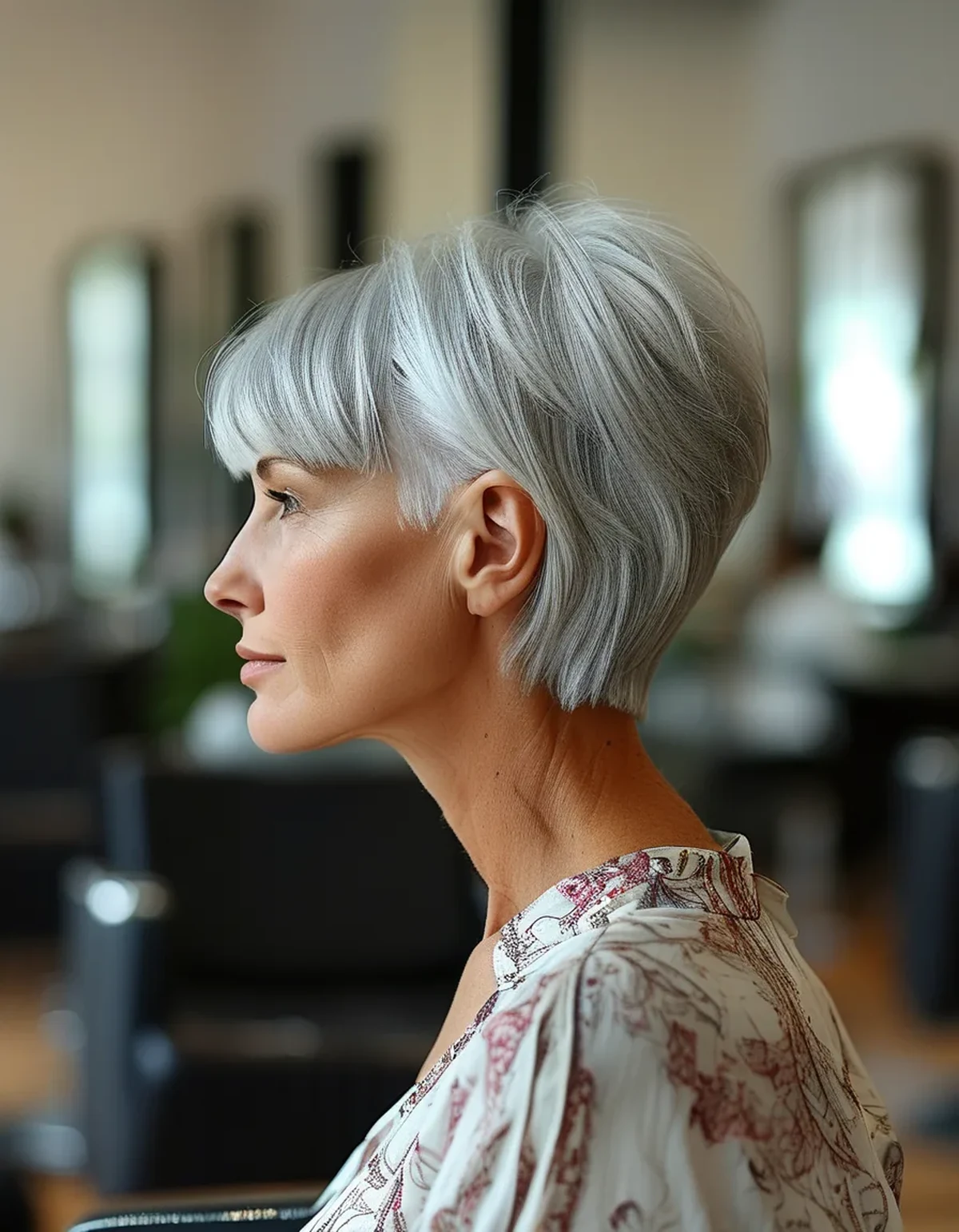
Interior layering, not surface layering. The goal is to remove weight from inside the shape so the hair collapses less at the root and expands less at the ends, without creating visible layer lines. Ask specifically for internal weight removal — a good stylist will know exactly what that means.
A softer perimeter. Point cutting or a lightly textured line takes the hard edge off without losing the shape. This is the single most impactful change for most people.
A shape with movement around the face. Soft, slightly longer face-framing pieces that move rather than sit flat. Movement catches light differently along its length, which is more flattering against skin than a solid reflective panel.
Length that respects the texture. Coarse gray hair often behaves best somewhere between the collarbone and the jaw, where there is enough weight to control expansion but not so much that it drags. That is a generalization, not a rule — density and wave pattern matter more than the number.
Working with the wave. A significant number of people find their hair develops or increases wave as it grays. Cutting to accommodate that wave, rather than cutting for the straight hair you used to have, changes the result completely.
Myth vs Fact: gray hair and haircuts
Myth: Gray hair means you should cut it short.
Fact: There is no length rule. Long silver hair looks striking when it is cut with enough interior work to keep it moving. What people are reacting to when they say this is unmaintained long gray hair — dry ends, no shape — which would look tired at any color.
Myth: Gray hair is more fragile so it needs less cutting.
Fact: Gray hair is often structurally more robust in diameter but more prone to dryness and breakage at the ends because of moisture loss. It typically needs more regular trimming, not less, because dry damaged ends on translucent hair are highly visible.
Myth: A gray cut needs more styling product.
Fact: It needs different product — more emphasis on moisture and less on hold. Heavy hold products on coarse hair produce stiffness, and stiffness on silver hair reads as aging in a way it does not on pigmented hair. Lightweight oils and creams do more than gels and hairsprays.
Myth: Purple shampoo is part of the cut conversation.
Fact: Toning is a color question and overuse produces a dull violet cast. It has nothing to do with shape, and no toning product fixes a cut that does not suit the texture.
FAQ: Gray Hair Cut Questions, Answered
How do I explain what I want to a stylist?
Describe the behavior, not the style name. “My hair has gotten coarser and it expands at the sides by midday” gives a stylist far more to work with than a photograph of someone with different hair. Bring the photo too, but lead with the behavior.
How often should I get it cut during the grow-out?
Every 8 to 10 weeks is a common rhythm during a transition, partly for shape and partly because regular small shape adjustments make the growing-out line far less obvious than infrequent large cuts do.
Will a fringe work with coarse gray hair?
It can, but it needs to be cut with the texture — a solid heavy fringe on coarse hair tends to separate and stick out. A softer, slightly longer, textured fringe is generally more cooperative and needs less daily work.
TL;DR:
- Gray hair is often coarser, drier and translucent, so it holds shape harder and shows blunt lines more.
- Heavy blunt perimeters, unlayered long hair and flat-dependent styles are what typically stop working.
- Ask for interior weight removal, a softened perimeter, and movement around the face.
- Cut for the wave you have now, not the hair you used to have.
- Trim more often, not less, and shift products toward moisture rather than hold.
The cut that stopped working did not stop because of you. It stopped because the material changed, and the material is the thing a cut is designed around.
Keep Reading
This article is for general informational and styling purposes only. Fit, sizing, and product availability may vary.