Does Diet Actually Affect How Fast You Go Gray?
Quick Answer: Genetics is the dominant driver of when and how graying happens for most people, but a genuine deficiency in specific nutrients — particularly vitamin B12, copper, and to a lesser extent vitamin D — has been linked in some research to premature graying that can, in those specific deficiency cases, partially reverse once the deficiency is corrected, meaning diet’s role is real but limited mostly to correcting an actual deficiency rather than preventing genetically programmed graying.
The honest framing is that diet can address a specific, testable subset of premature graying cases, not that nutrition generally controls graying timing for most people.

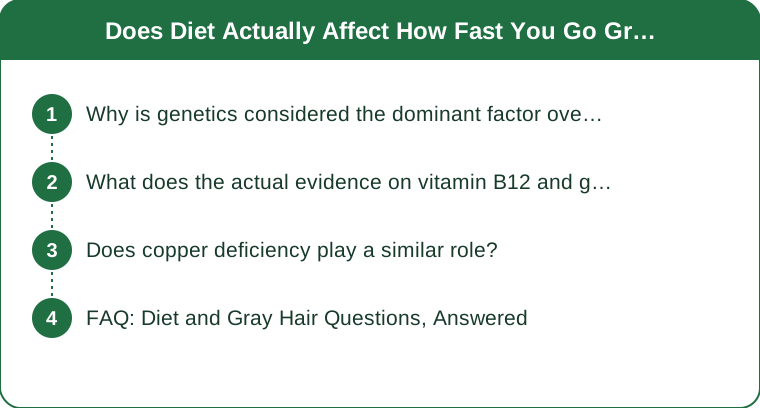
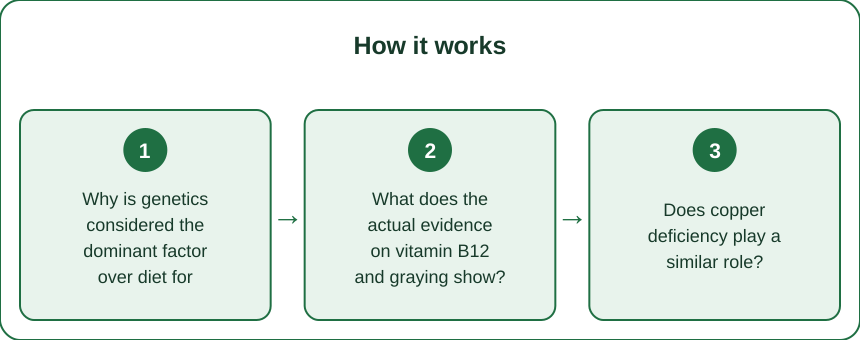
Why is genetics considered the dominant factor over diet for most graying?
The timing of graying is substantially determined by genetically programmed decline in melanocyte (pigment-producing cell) activity within hair follicles, a process that occurs on a broadly predictable timeline across generations within families — this genetic program isn’t something diet meaningfully overrides for people without an underlying nutritional deficiency.
What does the actual evidence on vitamin B12 and graying show?
Vitamin B12 deficiency has a documented, if not extremely common, association with premature graying in some studies, and in cases where an actual deficiency was identified and corrected through supplementation or dietary change, some reversal of premature graying has been reported — this is a specific, testable deficiency case, not a general claim that more B12 slows graying in people with normal levels.

Does copper deficiency play a similar role?
Copper is a cofactor for the enzyme involved in melanin production, and severe copper deficiency has been linked to graying in some research, though this specific deficiency is considerably less common in typical diets than B12 deficiency, making it a less frequently relevant factor for most people investigating their own graying.
FAQ: Diet and Gray Hair Questions, Answered
Should I get bloodwork done if I’m noticing premature graying?
If graying seems notably early relative to family history, checking B12 and general nutritional status with a doctor is a reasonable step, since it’s a testable and potentially correctable factor, unlike the genetic component of graying timing.
Will taking B12 supplements slow graying if my levels are already normal?
There’s limited evidence that supplementing beyond already-sufficient levels provides additional anti-graying benefit — the documented improvements are specifically in cases of an actual, corrected deficiency.
Are there specific foods that directly prevent graying regardless of overall diet quality?
No single food has strong evidence for directly preventing genetically programmed graying — a generally balanced diet that avoids deficiency in key nutrients (B12, copper, vitamin D) addresses the diet-related portion of the picture, but doesn’t override genetic timing.
TL;DR:
- Genetics is the dominant, largely diet-independent driver of graying timing for most people
- A confirmed vitamin B12 deficiency has the strongest documented link to premature graying
- Copper deficiency plays a similar but less commonly relevant role
- Bloodwork, not assumption, is the reliable way to know if diet is actually a factor in your case
Diet’s real role in graying is narrow but genuine — worth checking for an actual deficiency rather than expecting general nutrition changes to meaningfully slow a genetically timed process.
Keep Reading
This article is for general informational and styling purposes only. Fit, sizing, and product availability may vary.