Gray Hair and the Sun (Why It Turns Yellow in Summer)
Quick Answer: Gray hair turns yellow in summer because it has no pigment to mask staining and a more porous cuticle that absorbs everything it meets — UV, chlorine, hard-water minerals and product residue. The fix is mostly prevention: wear a hat in strong sun, use a UV-protective leave-in, wet your hair before swimming and rinse immediately after, clarify monthly for mineral buildup, and use a purple toning shampoo sparingly (once a week or less — overuse turns silver dull or lilac).
You spend a summer being pleased with your silver, and then one September morning in decent light you notice it: a warm, brassy cast around the front, like the hair got left out too long. Which, in a sense, it did.
Gray hair has one vulnerability that pigmented hair doesn’t — it can’t hide anything.

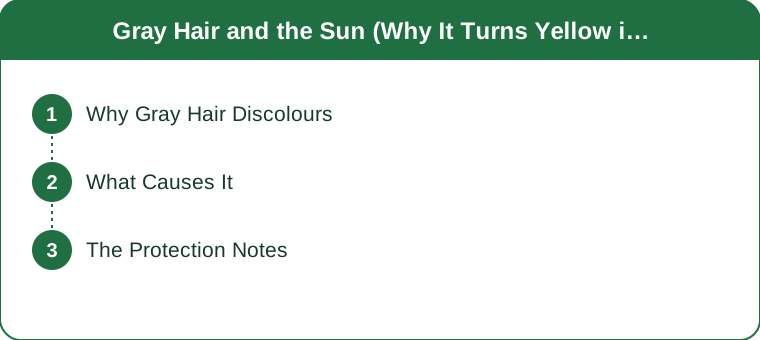
Why does gray hair turn yellow?
There’s no pigment to mask it. Brown hair picks up exactly the same mineral deposits and product residue — you simply can’t see them against existing color. Against silver, every bit of warmth is on full display.
The cuticle is often more porous. Gray hair frequently has a different texture — coarser, drier, with a cuticle that doesn’t lie as flat. A porous cuticle is an open door.
So it absorbs whatever it meets. Minerals from your shower water, chlorine from the pool, residue from styling products, environmental pollutants. Porous hair takes these up and holds onto them, and they oxidize into yellow tones.
And it shows up across the whole head at once, evenly, which is what makes it read as a change in your hair color rather than as staining. Front sections and the crown usually go first — they get the most sun.
Worth reframing: this is a visibility and deposit problem, not damage in the usual sense. Which is genuinely good news, because deposits can be removed.

What actually causes the yellowing?
The usual sources, roughly in order of impact over a summer:
- UV exposure. Sunlight oxidizes the hair’s protein structure, and on unpigmented hair that oxidation reads as yellow. This is why the discoloration is seasonal and why it’s worst on the top and front.
- Chlorine and pool water. The fastest offender by a distance — a few weeks of regular swimming can visibly shift silver hair. (Note: the greenish tint swimmers get is copper in the water, not chlorine itself.)
- Hard water minerals. Calcium, magnesium and iron deposit with every wash and accumulate steadily. If you have hard water, this is likely a bigger contributor than the sun.
- Product buildup. Silicones, waxes and styling residue accumulate, oxidize and yellow — especially with dry shampoo and hairspray.
- Heat styling. Repeated high heat contributes to the same oxidative yellowing, particularly above 350°F.
- Smoke and environmental exposure. Cigarette smoke is notorious on white hair; cooking smoke, wood smoke and urban pollution all contribute.
- Warm-toned products. Some shampoos, conditioners and oils are themselves slightly yellow or golden, and porous silver hair will take that up.
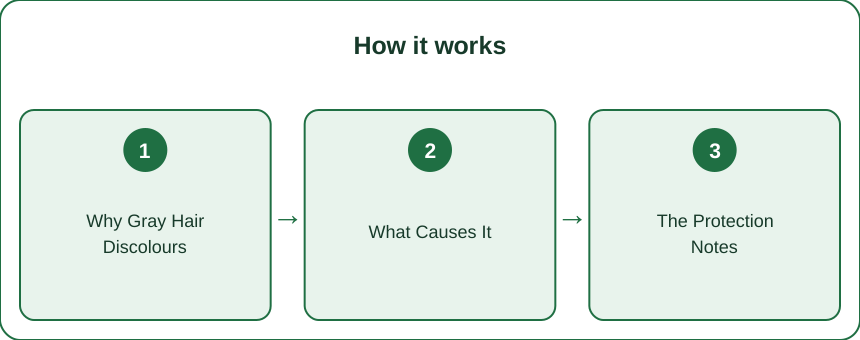
How do you protect gray hair from yellowing?
Prevention is far easier than correction. Seven habits:
1. Wear a hat in strong sun. Physical shade is the single most effective protection there is, and it costs nothing. A wide brim through July and August does more than any product.
2. Use a UV-protective leave-in. Sprays and leave-in conditioners with UV filters are the practical answer when a hat isn’t happening. Reapply after swimming.
3. Wet your hair before the pool. Hair absorbs like a sponge — saturate it with clean water first and there’s much less capacity left for chlorinated water. Better still, add a leave-in conditioner as a barrier.
4. Rinse immediately after swimming. Not when you get home. Chlorine sitting in your hair for two hours is the difference between fine and brassy by August.
5. Use a purple or blue toning shampoo — sparingly. Purple neutralizes yellow; blue targets more orange tones. Once a week or less is the right dose, left on for 2–3 minutes, not fifteen. This is the product people most often overdo.
6. Don’t overuse toning products. Too much and silver goes flat, dull, or faintly lilac — and on porous hair it can grab unevenly. If your hair looks grayish-dull rather than bright, back off the purple for a few weeks.
7. Clarify periodically. A clarifying or chelating shampoo once a month removes mineral and product buildup. Chelating specifically (look for EDTA or phytic acid) is the one that targets hard-water minerals, and it’s the treatment that most reliably surprises people with how much brightness comes back. Follow it with a deep conditioner — clarifying is drying, and gray hair is dry to begin with.
If you have hard water and you’re fighting this year-round, a shower filter is the fix that works while you’re not thinking about it.
5 Mistakes Everyone Makes With Silver Hair
- Using purple shampoo every wash. The most common error by far. It builds up, dulls the shine, and can tint the hair lilac — then people conclude their hair “went dull” and use more.
- Blaming the sun when it’s the shower. Hard water is the year-round culprit hiding behind the seasonal one. If the yellowing doesn’t fade in winter, it isn’t UV.
- Skipping conditioner because gray hair looks coarse. Coarse and dry is exactly the texture that needs moisture — and a smoother cuticle absorbs fewer deposits in the first place.
- Waiting until it’s yellow to act. Prevention takes ten seconds; correction takes weeks of clarifying and toning.
- Jumping straight to a salon color correction. The third mistake catches most people, but this one costs the most — try a chelating treatment and a deep conditioner first. A surprising share of “yellowed” hair is just mineral buildup and comes out in one wash.
Mini FAQ
How often should I use purple shampoo on gray hair?
Once a week is plenty for most people, and every two weeks is often better if your hair is very porous. Leave it on 2–3 minutes and rinse well. If your silver starts looking dull, flat or faintly violet, stop for a few weeks and use a clarifying shampoo to reset.
Can yellowed gray hair be fixed, or is it permanent?
It’s almost always reversible. Deposit-based yellowing (minerals, product, chlorine) responds well to a chelating shampoo followed by a toning treatment — often within one or two washes. UV-oxidized yellowing is more stubborn but improves with toning and fades as new hair grows in.
Does sun damage gray hair more than pigmented hair?
Melanin provides some natural UV protection, so unpigmented hair does lack that defense — and it shows every effect immediately besides. That’s a good argument for a hat and a UV leave-in, and also for treating your scalp with the same care, since gray hair often comes with a scalp that’s had less shade over the years.
TL;DR:
- Gray yellows because there’s no pigment to mask deposits, and the cuticle is often more porous.
- Causes: UV, chlorine, hard-water minerals, product buildup, heat, smoke.
- A hat is the best protection; a UV leave-in is the backup.
- Wet hair before the pool, rinse immediately after.
- Purple shampoo once a week or less — overuse dulls or tints it.
- Chelating shampoo monthly for hard-water minerals, then deep condition.
Most yellowing is buildup, not damage — and buildup washes out.
Keep Reading
This article is for general informational and styling purposes only. Fit, sizing, and product availability may vary.