Gray Hair Gets Drier the Week the Heating Comes On
Quick Answer: Gray hair produces less sebum, has a more open cuticle, and is often coarser, so it loses moisture faster than pigmented hair. When indoor heating drops humidity sharply, gray hair shows it within days — more frizz, more tangling, more breakage, and a duller silver. The fixes are a humidifier, a leave-in conditioner, less heat styling, and a weekly deep treatment.
The heating comes on for the first time and within a week your hair is frizzing, tangling, and looking dull in a way it was not in September.
This happens to everyone’s hair to some degree. Gray hair just has less margin.

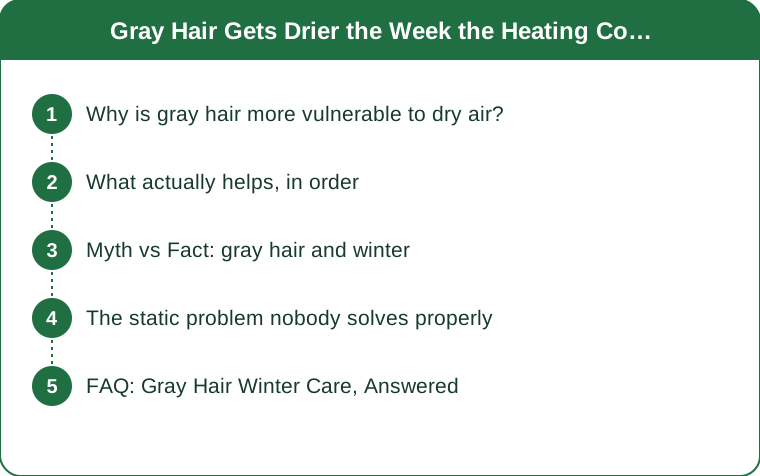
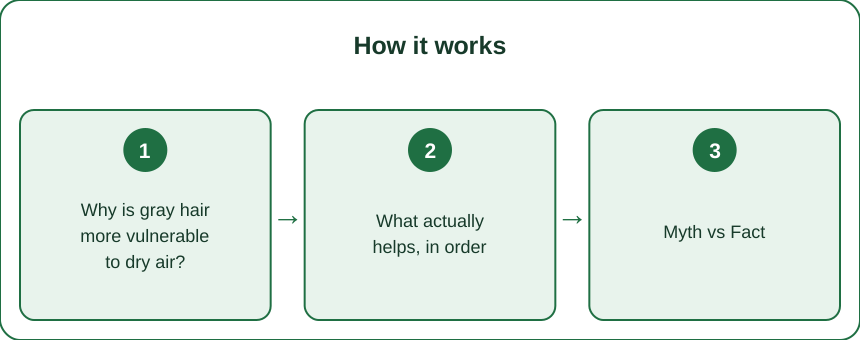
Why is gray hair more vulnerable to dry air?
Three structural differences, all of which reduce moisture retention.
1. Sebum production declines. The scalp produces less oil with age, and sebum is the hair’s natural conditioner — it travels down the strand and seals the cuticle. Less sebum means a strand that is less protected from the start.
2. The cuticle sits differently. Gray hair often has a rougher, more raised cuticle, and a raised cuticle both loses moisture faster and reflects light less evenly. This is why gray hair can look dull even when it is healthy — the surface is scattering light rather than reflecting it cleanly.
3. The texture frequently changes. Many people find gray hair comes in coarser and wirier, sometimes with a different curl pattern entirely. Coarser hair has a larger diameter and a thicker cuticle layer, which sounds protective but in practice means it resists absorbing moisture as well as losing it.
Then add the environment. Indoor heated air in winter can be extraordinarily dry — often comparable to desert humidity levels. Hair exchanges moisture with the surrounding air continuously, and dry air pulls water out of the strand all day and all night.
Why the change feels sudden: it usually is. The heating comes on over a weekend, indoor humidity drops sharply, and hair responds within days. This is one of the few hair changes with a specific, identifiable trigger date, which also makes it one of the easiest to get ahead of.
What actually helps, in order
1. A humidifier. This is the highest-return change and it is not a hair product. Raising the humidity in your bedroom addresses the cause rather than compensating for it. You spend seven or eight hours a night in that air, and the difference over a week is noticeable in hair and skin at once.
2. A leave-in conditioner, used daily. This is the highest-return product change. A leave-in provides a persistent moisture layer that rinse-out conditioner cannot — rinse-out conditioner does its work in the shower and most of it goes down the drain.
Apply to damp hair, mid-length to ends, every wash. For coarse gray hair, a cream leave-in generally outperforms a spray.
3. Wash less often, and cooler. Hot water strips what little sebum there is. Warm rather than hot, and stretch the interval between washes — with lower sebum production, gray hair usually tolerates less frequent washing well.
4. A weekly deep treatment. A mask or deep conditioner once a week, left on for the full recommended time. Heat helps penetration — a shower cap for ten minutes is genuinely more effective than the same product applied and rinsed quickly.
5. Reduce heat styling. Dry air plus heat styling is compounding damage. If you use heat, use a heat protectant every time and drop the temperature — most styling tools run hotter than necessary, and coarse gray hair does not require maximum heat.
6. Change the pillowcase. Silk or satin reduces overnight friction substantially. For hair that is already fragile from dryness, this is a real reduction in mechanical damage for a one-time cost.

Myth vs Fact: gray hair and winter
Myth: Gray hair is more fragile because it has no pigment. Fact: the absence of melanin does not make the strand structurally weaker. The fragility comes from reduced sebum, cuticle condition, and texture changes — related to age rather than to the loss of pigment itself.
Myth: Purple shampoo fixes winter dullness. Fact: purple shampoo neutralizes yellow tones and does nothing for moisture. Using it more often to address dullness usually makes things worse, since many purple formulas are drying. Dullness from dryness needs conditioning, not toning.
Myth: Oiling the hair replaces lost moisture. Fact: oils seal moisture in; they do not add water. Oil applied to dry hair seals in the dryness. Apply to damp hair, after a water-based product, so there is something to seal.
Myth: You need to wash gray hair more often because it gets greasy at the roots. Fact: with reduced sebum production, most people find the opposite. If your roots are greasy while your ends are dry, that is a product and technique problem — condition the ends only, and wash the scalp rather than the length.
Myth: Frizz means you need more product. Fact: winter frizz is usually a moisture deficit and sometimes static from dry air. More styling product on a dehydrated strand adds weight without addressing the cause, and static specifically responds to humidity rather than to product.
The static problem nobody solves properly
Static is a distinct problem from dryness and it needs a different answer.
What causes it: dry air allows electrical charge to build on the hair surface, and friction — from hats, scarves, brushing, pillowcases — generates it. Individual strands with the same charge repel each other, which is the flyaway effect.
Why gray hair shows it more: a rougher cuticle generates more friction, and lower sebum means less natural conductivity on the strand surface.
What actually works:
Raise the humidity. Static is fundamentally a dry-air phenomenon and it largely disappears above a moderate humidity level. This is the real fix.
Change the brush. Plastic bristles generate substantially more static than natural boar bristle or wood. A boar bristle brush also distributes what sebum you have down the strand, which addresses two problems at once.
A leave-in conditioner or a light oil on the ends adds surface conductivity and weight.
Silk or satin lining in hats and scarves. Wool against hair is one of the biggest static generators in winter. A silk-lined beanie eliminates most hat-related static and this is a genuinely underused fix.
A dryer sheet lightly over the hair surface works in an emergency. It is not elegant and it is effective.
What does not work: more hairspray, which stiffens rather than discharging; and brushing more, which generates more charge with every stroke.
FAQ: Gray Hair Winter Care, Answered
How often should I deep condition in winter?
Once a week for most gray hair, twice if it is coarse and very dry. If hair starts feeling limp or coated, reduce the frequency — over-conditioning is a real thing and it presents as weightless-looking, flat hair.
Does hard water make winter dryness worse?
Yes. Mineral deposits build on the cuticle and make hair feel rough and look dull, and they affect gray hair visibly because the deposits can also cause yellowing. A chelating shampoo once or twice a month helps.
Should I switch shampoo for the winter?
A more moisturizing, sulfate-free formula is usually a worthwhile seasonal change. Keep purple shampoo in rotation for tone but use it less often than in summer, and always follow it with conditioner.
Why does my gray hair look more yellow in winter?
Usually a combination of product buildup, hard water minerals, and indoor lighting. Warm indoor light emphasizes yellow tones, so some of what you see is the room rather than the hair.
TL;DR: Gray hair has less margin, and indoor heating removes what is left.
- Three structural differences: less sebum, a more raised cuticle, and often a coarser texture. All three reduce moisture retention.
- Indoor heated air can reach desert-level dryness, and hair loses water to it continuously.
- A humidifier does more than any product. It fixes the cause instead of compensating.
- A daily leave-in conditioner is the highest-return product change — rinse-out conditioner mostly goes down the drain.
- Oil seals moisture in; it does not add it. Apply to damp hair, never dry.
- Static needs a separate fix: humidity, a boar bristle brush, and silk-lined hats. Not more hairspray.
Put a humidifier in the bedroom the week the heating goes on, not the week your hair starts complaining.
Keep Reading
This article is for general informational and styling purposes only. Fit, sizing, and product availability may vary.