The Hormone Connection Behind Premature Gray Hair Nobody Really Talks About
Quick Answer: While genetics is the primary driver of when hair turns gray, thyroid dysfunction and significant hormonal shifts (perimenopause, chronic stress affecting cortisol) can accelerate the process or trigger a noticeable increase in gray strands within months. It’s a real contributing factor, not the main cause for most people.
You notice a sudden uptick in gray strands and wonder if it’s just “finally your turn” genetically, or something else going on. For a meaningful subset of people, a hormonal shift is quietly part of the answer.

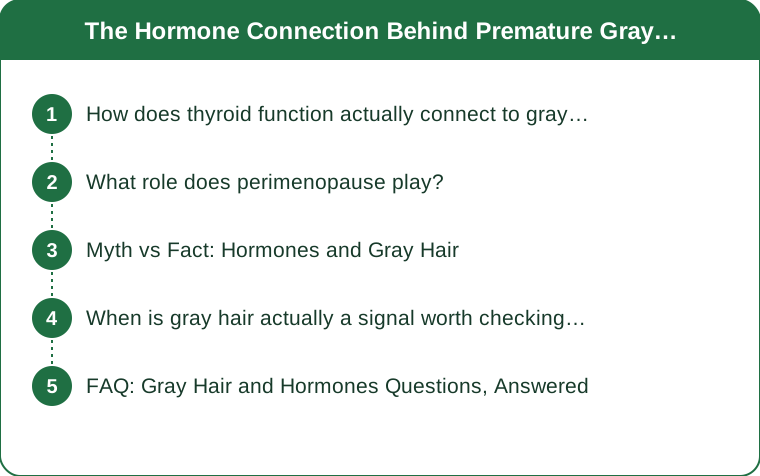
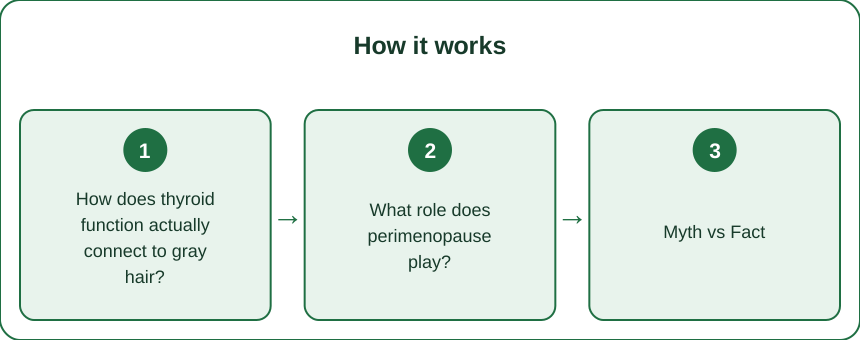
How does thyroid function actually connect to gray hair?
Melanocytes (the cells producing hair pigment) are sensitive to thyroid hormone levels — both hypothyroidism and hyperthyroidism have been associated with premature graying in research, since thyroid hormones influence melanocyte function and hair follicle cycling.
This doesn’t mean every case of gray hair signals a thyroid problem, but a sudden, rapid increase in graying alongside other symptoms (fatigue, weight changes, temperature sensitivity) is worth mentioning to a doctor rather than assuming it’s purely genetic timing.
What role does perimenopause play?
Estrogen decline during perimenopause has been linked to reduced melanocyte activity and function, which can accelerate graying that might otherwise have progressed more gradually. This is one of several hair changes (alongside texture and thinning) commonly reported during this transition.
The timing overlap between perimenopause and typical age-related graying makes the two hard to fully separate, but the hormonal contribution appears to be real and additive to genetic timing, not purely coincidental.

Myth vs Fact: Hormones and Gray Hair
Myth: Stress alone turns hair gray overnight. Fact: The mechanism is more gradual — chronic stress affecting cortisol can accelerate existing graying processes over months, not instantly overnight as popular stories suggest, though sudden stress may reveal gray strands faster as hair growth cycles shift.
Myth: Fixing a hormonal imbalance will reverse existing gray hair. Fact: Addressing an underlying thyroid or hormonal issue may slow further graying, but hair that has already lost pigment typically doesn’t regain color — the effect is preventive going forward, not reversive.
When is gray hair actually a signal worth checking with a doctor?
Rapid graying over just a few months, especially alongside fatigue, unexplained weight change, or temperature sensitivity, is worth a thyroid panel — these together suggest a hormonal driver worth ruling out rather than assuming pure genetics.
Gradual graying over years, consistent with family history and age, generally doesn’t need medical investigation on its own. This is general information, not medical advice — a physician can distinguish concerning patterns from typical aging.
FAQ: Gray Hair and Hormones Questions, Answered
Can treating a thyroid condition stop further graying?
It may slow the acceleration caused by the thyroid imbalance specifically, though genetic graying will still progress at its own underlying rate.
Does perimenopause definitely cause more gray hair?
It’s associated with accelerated graying for many people due to estrogen’s role in melanocyte function, but the extent varies significantly by individual.
Is there a supplement that reliably prevents hormone-related graying?
No supplement has strong evidence for reversing or reliably preventing hormone-driven graying — addressing the underlying hormonal issue with a doctor is the evidence-based approach. This is general information, not medical advice.
TL;DR:
- Genetics remains the primary driver, but thyroid and hormonal shifts are real contributing factors
- Thyroid dysfunction affects melanocyte function and can accelerate graying
- Perimenopause’s estrogen decline is linked to faster graying for many people
- Rapid graying with other symptoms warrants a thyroid check, not just genetic acceptance. This is general information, not medical advice.
Keep Reading
This article is for general informational and styling purposes only. Fit, sizing, and product availability may vary.